Making wise investment choices in uncertain times
The first quarter (Q1) of 2023 was a rollercoaster ride for investors. Market volatility unfolded following U.S. and European banking turmoil, and interest rates and inflation climbed—evoking investor fears about financial stability. As of March 31, 2023, the year-to-date performance is as follows: S&P 500 Price Index = + 7.0 percent, S&P / TSX Price Index = +3.7 percent, MSCI EAFE = +7.6 percent, Nasdaq = +16.8 percent.
Here’s a closer look at the areas that made their mark in Q1 2023, and will continue to shape the economy throughout the year.
Interest rates increased after COVID. To minimize the economic impact of COVID shutdowns, governments worldwide provided trillions of dollars in support through federal subsidies and low-interest rates. With excess money and an imbalance between the supply and demand of goods and services, inflation rose globally to levels not seen in decades. Once countries reopened and economies were on solid footing, central banks shifted their focus to reducing inflation. Global central banks began to raise interest rates, some more aggressively than others.
A sizeable increase in interest rates, predominantly in North America, has exposed some individuals and companies who may be unable to weather higher costs during a slowing economy.
Bank failures added to the uncertainty.
Most recently, market volatility ensued on the signs of trouble in the U.S. and European banking sectors. In the short term, we're likely to experience more volatility as the market digests the ongoing fallout from regional banks and potential price swings in other market areas. We believe inflation will continue to trend lower (our view is four percent by the end of the year). And should that be the case, central banks, such as the U.S. Federal Reserve, are likely getting close to ending their rate hike cycle if they're not already there.
Making the right financial choices in difficult times.
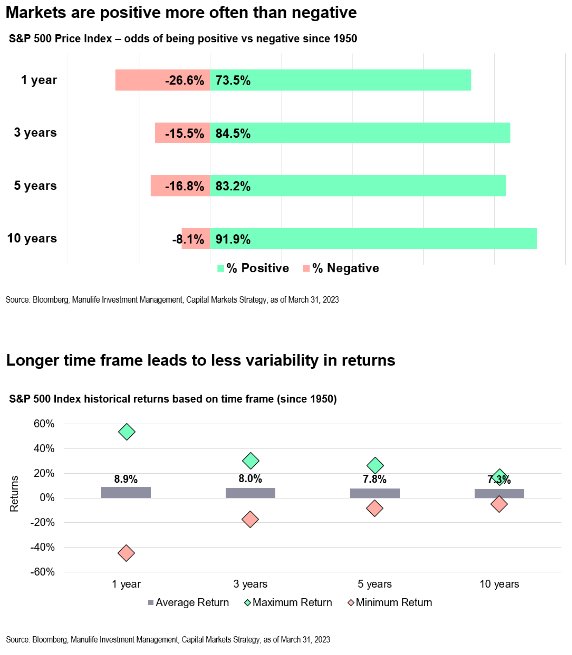
As the tables illustrate, investing in a time frame of greater than three years increases the odds of success. The tables show returns and the odds of being positive for four different time frames: 1, 3, 5, and 10 years since 1950. Three main points to note:
• Over the short term (one year), the average return was highest, but the range in returns was by far the widest: a maximum return of 54 percent to a minimum return of –45 percent. Markets are volatile in the short term, and the odds of being positive are only 74 percent.
• Over the long term (10 years), the average return was the lowest at 7.3 percent. However, the range in returns was small: a maximum return of 17 percent to a negative return of –5 percent, with the odds of being positive at 92 percent.
• Over the medium term (3–5 years), returns were approximately 8 percent, with the shorter three-year term having a wider range. The odds of being positive are approximately 85 percent.
So how do you best invest for success? The historical data are clear: markets are much more volatile in the short term, whereas long-term investing increases the odds of positive returns. Perhaps this quote best captures the essence of how we should approach our investments during periods of short-term volatility:
“Investing is like soap: the more you touch it, the smaller it gets.” —Darcy Howe
As always, we are here to talk if you have any questions about the markets or your investments.
This newsletter has been prepared by Raymond James Ltd. (“RJL”). It expresses the opinions of the writer, and not necessarily those of RJL. Statistics, factual data and other information are from sources believed to be reliable, but accuracy cannot be guaranteed. It is furnished on the basis and understanding that RJL is to be under no liability whatsoever in respect thereof. It is for information purposes only and is not to be construed as an offer or solicitation for the sale or purchase of securities. RJL, its officers, directors, employees and their families may from time to time invest in the securities discussed in this newsletter. It is intended for distribution only in those jurisdictions where RJL is registered as a dealer in securities. Distribution or dissemination of this newsletter in any other jurisdiction is strictly prohibited. This newsletter is not intended for nor should it be distributed to any person residing in the USA. Raymond James Limited is a Member Canadian Investor Protection Fund.


Raymond James Ltd. is an indirect wholly-owned subsidiary of Raymond James Financial, Inc., member – Canadian Investor Protection Fund and member of the Canadian Investment Regulatory Organization (CIRO)
Securities-related products and services are offered through Raymond James Ltd. Insurance products and services are offered through Raymond James Financial Planning Ltd, which is not a member of the Canadian Investor Protection Fund. Raymond James' Estate and Trust Services are offered by Solus Trust Company and Raymond James. Trust (Québec) Ltd. Solus Trust Company (“STC”) provides services in the provinces of British Columbia, Alberta, Saskatchewan, and Ontario. Raymond James Trust (Québec) Ltd. (“RJTQ”) provides services in the province of Québec. Services provided by STC and RJTQ are not covered by the Canadian Investor Protection Fund. STC and RJTQ are affiliates of Raymond James Ltd.
Use of the Raymond James Ltd. website is governed by the Web Use Agreement | Client Concerns.



© 2024 Raymond James Ltd. All rights reserved.
Privacy Policy | Advisor Website Disclaimers | Manage Cookie Preferences