Here’s Exactly How Much You’d Need to Invest Each Month to Hit $1,000,000 by Age 65 (And Why Waiting Even 10 Years Can Cost You Hundreds of Thousands)
Becoming a millionaire isn’t a fantasy reserved for founders, lottery winners, or Bay Street executives. It’s math. With enough time, consistency, and compounding, reaching $1,000,000 becomes not only achievable but surprisingly realistic.
Yet despite all the articles and TikTok gurus shouting, “invest early,” very few actually show the numbers behind the advice. How much do you really need to invest each month? What happens if you wait? And how severely does a 10-year delay impact your long-term wealth?
Let’s break it down clearly and practically. No jargon, no hype, just the math.
The Power of Compounding: Your Most Valuable (and Irreplaceable) Asset
Compounding is the process where your investments generate returns, and then those returns generate more returns. It’s slow at first, then explosively fast.

Assuming a 7% average annual return, which reflects the long-term historical return of a balanced equity- heavy portfolio, it becomes clear that time in the market matters more than the amount invested.[1]
So, let’s run the numbers.
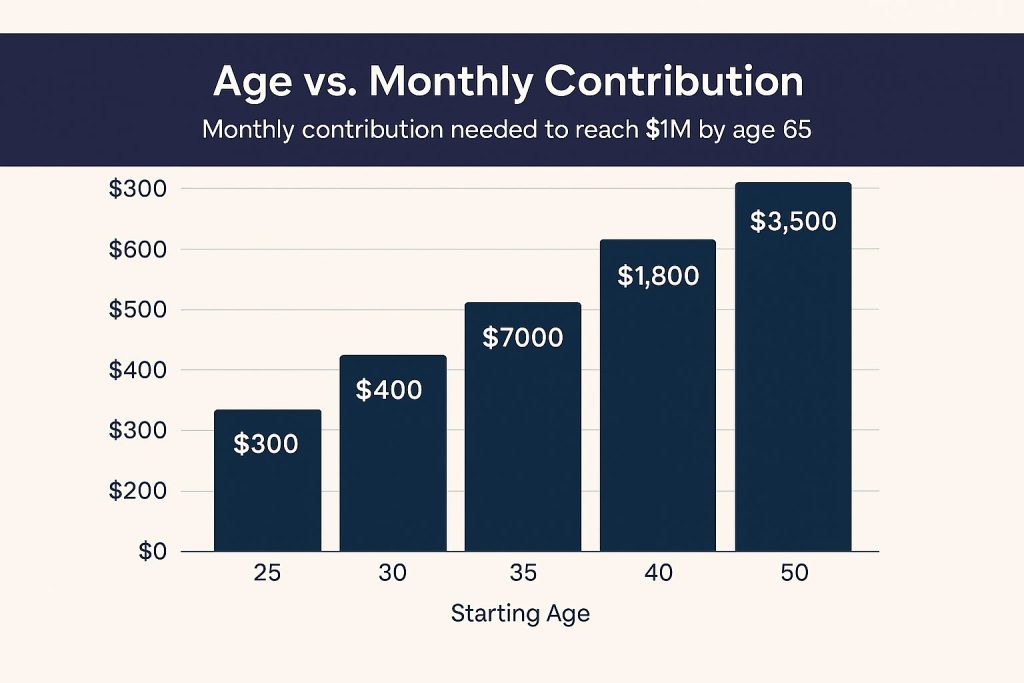
How Much You Need to Invest Each Month to Reach $1,000,000 by Age 65
Below are the monthly contributions required to reach $1,000,000 by age 65, assuming a 7% return.[2]
We’ll compare starting ages: 25, 30, 35, 40, 45, and 50.
| Starting Age | Years to Grow | Monthly Contribution Needed |
| 25 | 40 | $300 per month |
| 30 | 35 | $440 per month |
| 35 | 30 | $700 per month |
| 40 | 25 | $1,100 per month |
| 45 | 20 | $1,800 per month |
| 50 | 15 | $3,500 per month |
Let that sink in.
Starting at 25 years old:
You need $300 per month.
Starting at 35 years old:
You need more than double, about $700 per month.
Starting at 45 years old:
You need six times more, $1,800 per month.
Why Waiting 10 Years Costs You Hundreds of Thousands
Let’s compare two real scenarios.
Investor A: Starts at age 25, investing $300 per month
• Total contributions: $144,000
• Value at 65: $1,000,000
Investor B: Starts at age 35, investing $300 per month
• Total contributions: $108,000
• Value at 65: $450,000
Same monthly contribution.
Same investments.
Same return rate.
Only a 10-year difference.
Result: a $550,000 gap.
Waiting 10 years doesn’t just cost you a decade of deposits. It costs you the growth on those deposits.
You can increase contributions to catch up, but you can’t replace lost time.
The Cost of Delay: A Visual Breakdown
If you invest $300 per month:
| Starting Age | Value at 65 |
| 25 | $1,000,000 |
| 30 | $700,000 |
| 35 | $450,000 |
| 40 | $280,000 |
Waiting from age 25 to age 35 costs you more than $550,000.
Waiting from age 25 to age 40 costs you more than $720,000.[2]
This is the real reason financial planners beg people to start early. It is mathematically impossible to catch up without dramatically increasing contributions.
What If You Can’t Invest Much Right Now?
Most people in their 20s and early 30s aren’t swimming in cash. Rent, groceries, childcare, and student loans eat up your budget.
Here is the good news:
Even small amounts have massive impact when given enough time.
• $50 per month from age 25 grows to $165,000
• $100 per month grows to $330,000
• $150 per month grows to nearly $500,000[2]
The goal isn’t to start big.
The goal is simply to start.
You can always increase contributions later as your income grows.
Where Should You Invest? (High Level Overview, Not Financial Advice)
While individual advice depends on your situation, Canadians typically build their long-term wealth through:
✔ Tax-Free Savings Account (TFSA)
Growth is tax free. Withdrawals are tax free. It is the most efficient compounding vehicle available.
✔ Registered Retirement Savings Plan (RRSP)
Contributions reduce taxable income. Ideal for high earners or those expecting lower income in retirement.
✔ Low-Cost Index Funds or ETFs
Automatic diversification, lower fees, and strong long-term performance relative to many actively managed funds.
✔ Auto Investing / Pre-Authorized Contributions
The easiest and most reliable way to stay consistent. No willpower required.
So… When Should You Start?

If your goal is to retire comfortably, or simply to give your future self financial freedom, the answer is simple:
Start as early as you possibly can, with whatever amount you can.
Not when you have more money.
Not when the market “feels right.”
Not when life gets less busy.
The cost of waiting is massive and irreversible.
Your future millionaire self is built not by luck or lotteries, but by small, consistent decisions starting today.
____________________________________________________________________________
[1] Calculations are based on standard compound interest methodology using assumptions consistent with FP Canada projection assumption guidelines, including monthly contributions, a 7% nominal annual rate of return, and investment to age 65. Projections are illustrative only and do not represent actual investment performance. Rates of return are not guaranteed and may vary.
[2] Future value estimates for monthly contributions of $50, $100, and $150 were calculated using compound growth projections consistent with FP Canada–approved financial planning assumptions. Results are for illustrative purposes only and are subject to market risk and variability.
____________________________________________________________________________
____________________________________________________________________________
This e-newsletter has been prepared by Christine LaLiberte and expresses the opinions of the author and not necessarily those of Raymond James Ltd. (RJL). Statistics, factual data and other information are from sources RJL believes to be reliable, but their accuracy cannot be guaranteed. It is for information purposes only and is not to be construed as an offer or solicitation for the sale or purchase of securities.
This newsletter is intended for distribution only in those jurisdictions where RJL and the author are registered. This provides links to other Internet sites for the convenience of users. Raymond James Ltd. is not responsible for the availability or content of these external sites, nor does Raymond James Ltd endorse, warrant or guarantee the products, services or information described or offered at these other Internet sites. Users cannot assume that the external sites will abide by the same privacy policy which Raymond James Ltd adheres to. Securities-related products and services are offered through Raymond James Ltd., member-Canadian Investor Protection Fund. Insurance products and services are offered through Raymond James Financial Planning Ltd., which is not a member-Canadian Investor Protection Fund.


Raymond James Ltd. is an indirect wholly-owned subsidiary of Raymond James Financial, Inc., member – Canadian Investor Protection Fund and member of the Canadian Investment Regulatory Organization (CIRO)
Securities-related products and services are offered through Raymond James Ltd. Insurance products and services are offered through Raymond James Financial Planning Ltd, which is not a member of the Canadian Investor Protection Fund. Raymond James' Estate and Trust Services are offered by Solus Trust Company and Raymond James. Trust (Québec) Ltd. Solus Trust Company (“STC”) provides services in the provinces of British Columbia, Alberta, Saskatchewan, and Ontario. Raymond James Trust (Québec) Ltd. (“RJTQ”) provides services in the province of Québec. Services provided by STC and RJTQ are not covered by the Canadian Investor Protection Fund. STC and RJTQ are affiliates of Raymond James Ltd.
Use of the Raymond James Ltd. website is governed by the Web Use Agreement | Client Concerns.



© 2024 Raymond James Ltd. All rights reserved.
Privacy Policy | Advisor Website Disclaimers | Manage Cookie Preferences